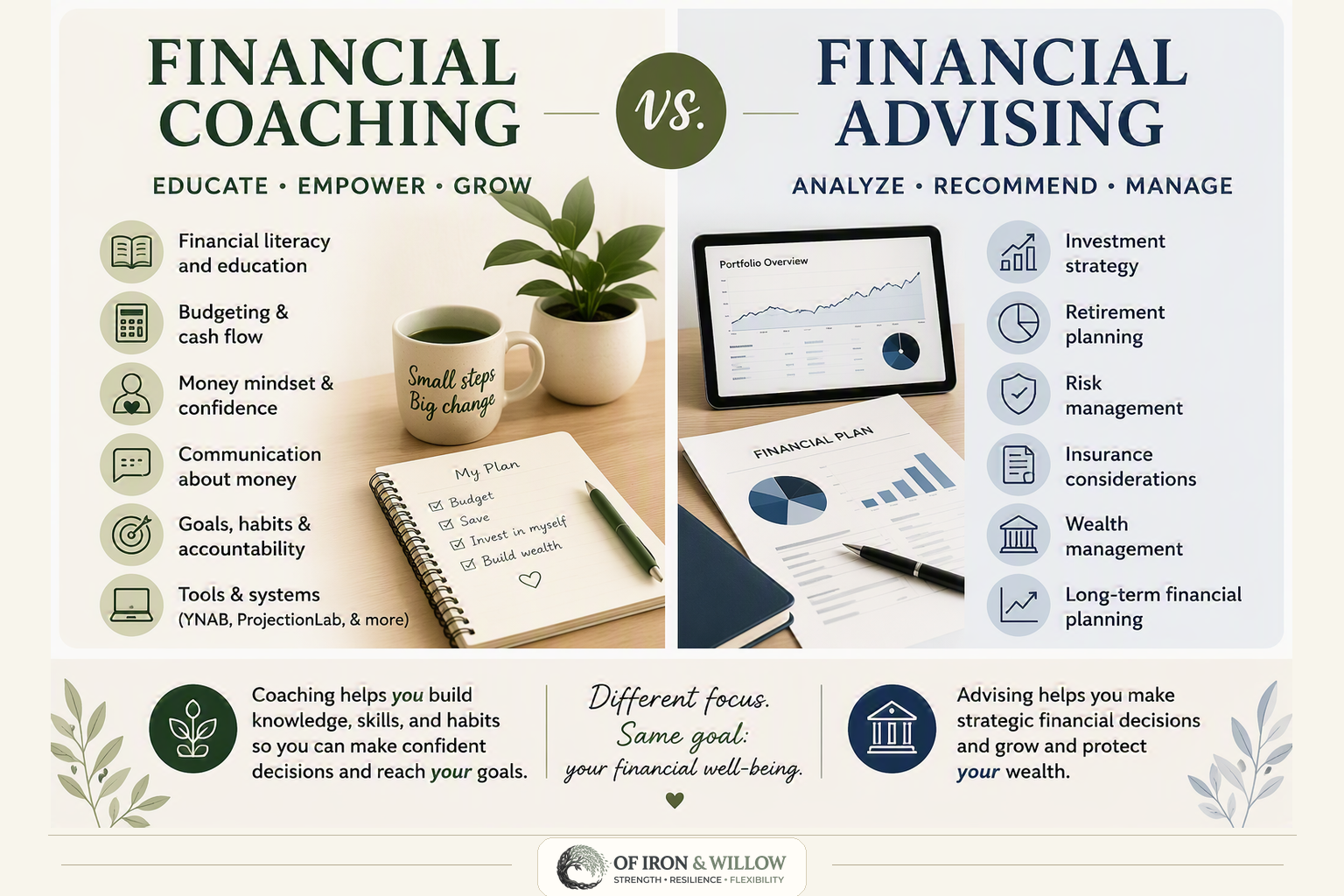
Financial coaching and financial advising both help people improve their financial lives, but they focus on different pieces of the puzzle. This post explains the difference between managing money and managing your relationship with money, when each type of support is most helpful, and how coaching can help bridge the gap between knowing what to do and consistently doing it.
What’s the difference?
Money is about more than spreadsheets and investment accounts.
It touches our values, habits, emotions, relationships, goals, and daily decisions. Yet many people aren’t sure where to turn when they want support with their finances.
A common question is:
“Do I need a financial coach or a financial advisor?”
The answer depends on what kind of help you’re looking for.
While both professionals help people improve their financial lives, they focus on very different parts of the financial picture. Understanding the distinction can help you find the right support for your current needs.
The Short Version
Think of it this way:
- A financial advisor helps manage assets, create investment strategies, and provide professional recommendations regarding investments, retirement planning, insurance, and wealth management.
- A financial coach helps people improve their relationship with money, increase financial literacy, build healthy financial habits, manage cash flow, reduce stress around money, and develop the confidence to make informed financial decisions.
Financial advisors are typically focused on investments, retirement planning, portfolio management, insurance strategies, and other financial products. They may receive compensation through fees, commissions, or a percentage of assets under management, depending on their business model.
Financial coaches focus on behaviors, habits, financial literacy, decision-making, financial confidence, spending, budgeting, goal achievement, accountability, communication around money, and creating systems that support long-term success.
Neither role is better than the other. They simply solve different challenges.
What Financial Advisors Do
Financial advisors are trained to help clients manage and grow their financial resources.
Depending on their credentials and services, they may help with:
- Investment management
- Retirement planning
- Asset allocation
- Risk management
- Insurance considerations
- Estate planning coordination
- Long-term wealth-building strategies
- Tax-efficient investing strategies (within their scope and credentials)
In short, they focus on the money itself.
Their expertise helps answer questions such as:
- How should I invest for retirement?
- Am I on track to retire?
- How should my portfolio be allocated?
- What investment strategy should I take?
- Which financial products best fit my situation?
Financial advisors help clients make financial decisions regarding their assets and long-term financial plans.
What Financial Coaches Do
Financial coaching focuses on the human side of money, but it also includes a strong emphasis on financial education and literacy.
A financial coach helps clients understand the thoughts, habits, behaviors, systems, and values that influence their financial lives. Rather than managing investments or recommending financial products, a coach helps clients build practical skills, increase financial knowledge, and develop the confidence to make informed decisions for themselves.
Financial coaching is designed to empower rather than direct.
For example, a financial coach may help you understand:
- How different retirement accounts work (401(k), 403(b), Traditional IRA, Roth IRA, etc.)
- The differences between Traditional and Roth contributions
- How Health Savings Accounts (HSAs) work and why they are often described as having a “triple tax advantage”
- The basics of investing concepts such as diversification, compound growth, and risk
- How to evaluate financial information and ask informed questions of financial professionals
- The fundamentals of budgeting, cash flow, and financial planning
However, a coach does not tell you which investments to purchase, which retirement account you should select, or how to allocate your assets. Those recommendations fall within the scope of financial advisors and other licensed professionals.
Instead, coaching focuses on helping you understand your options so you can make decisions that align with your goals, values, and circumstances.
Financial coaching may help clients:
- Build a sustainable budget or spending plan
- Improve financial literacy and understanding
- Increase awareness of spending patterns
- Identify “leaks” in their finances
- Create systems that support financial goals
- Reduce financial stress and overwhelm
- Align spending with personal values
- Improve communication around money
- Understand money mindsets, beliefs, and behaviors
- Navigate major financial transitions
- Develop confidence in financial decision-making
- Create accountability for financial goals
- Learn how to budget and manage cash flow for a small business
Many financial coaches also teach clients how to use financial tools and software to gain greater clarity about their financial lives.
For example, a coach may help clients use YNAB (You Need A Budget) to:
- Understand where their money is actually going
- Build awareness around spending habits
- Create intentional spending plans
- Track progress toward financial goals
- Plan for irregular expenses
- Reduce financial overwhelm
Similarly, a coach may help clients learn how to use ProjectionLab to model future scenarios and explore possibilities.
A coach can help clients:
- Build retirement projections
- Compare different savings rates
- Explore various retirement timelines
- Understand how changes in income or expenses may affect long-term goals
- Run “what-if” scenarios
The coach’s role is educational. They help clients understand the outputs and explore possibilities, but they do not recommend a specific strategy or tell clients which path to choose.
The goal is not to manage someone’s money.
The goal is to help people develop the knowledge, skills, systems, and confidence necessary to manage their own money more effectively.
Why Financial Basics Alone Aren’t Always Enough
Most people already know the basics:
- Spend less than you earn.
- Save consistently.
- Avoid unnecessary debt.
- Plan for the future.
Yet many people still struggle financially.
Why?
Because financial success isn’t only about knowing those things.
It’s also about skills, financial literacy, behavior, emotions, habits, self-awareness, communication, and creating systems that work in real life.
Many people were never taught:
- How retirement accounts work
- The differences between Traditional and Roth accounts
- How a 401(k), 403(b), or IRA fits into a broader financial plan
- How Health Savings Accounts (HSAs) can be used strategically
- The basics of investing, diversification, and compound growth
- How taxes can impact long-term wealth building
- How to evaluate financial information and make informed decisions
- How to use financial tools and systems to plan for the future
A person may be highly disciplined and motivated, yet still feel overwhelmed because they don’t fully understand the options and tools available to them.
Likewise, someone may understand financial concepts but struggle to consistently put them into practice.
That’s why financial coaching often includes both education and implementation.
It’s not just about learning financial concepts.
It’s also about understanding how those concepts apply to your life, values, goals, and day-to-day decisions.
Financial success often requires both:
Knowledge
Understanding how money, investing, retirement accounts, taxes, and financial systems work. Coaches can share resources that help you learn about these areas to gain important knowledge.
Action
Building the habits, routines, systems, and behaviors that allow you to use that knowledge consistently.
Financial coaching helps bridge both gaps.
It combines financial literacy with practical implementation so clients can make informed decisions and confidently act on them.
Because financial well-being isn’t simply about knowing what to do.
And it isn’t simply about trying harder.
It’s about having both the knowledge and the systems necessary to move forward.
Financial coaching acknowledges that money decisions are deeply personal. It helps clients build a financial life that works not just on paper, but in practice.
Can You Work With Both?
Absolutely.
In fact, many people benefit from having both.
A financial advisor may help determine an appropriate investment strategy and long-term wealth-building approach or manage those assets for clients.
A financial coach may help ensure that day-to-day habits support those larger goals.
For example:
- An advisor helps create a retirement strategy.
- A coach helps build the monthly habits that make consistent retirement contributions possible.
- An advisor helps evaluate investment, insurance, and estate planning options.
- A coach helps reduce financial avoidance, improve financial confidence, and increase follow-through.
- An advisor may recommend a specific course of action.
- A coach helps you understand the concepts, build the skills, and implement the habits that support your goals.
When each professional stays within their area of expertise, the two roles can complement one another extremely well.
How Do I Know Which One I Need?
Financial Coaching Might Be a Good Fit If:
- You feel overwhelmed by money.
- You want to learn more about how personal finance works.
- You want help creating a budget or spending plan.
- You struggle to follow through on financial goals.
- You want greater confidence with your finances.
- You want help understanding retirement accounts and financial concepts.
- You want to improve communication around money.
- You are experiencing financial stress or avoidance.
- You want your spending to better reflect your values.
- You want to use tools such as YNAB or ProjectionLab more effectively.
- You are navigating a major life transition and want support in building new systems.
Financial Advising Might Be a Better Fit If:
- You need investment recommendations.
- You want professional portfolio management.
- You need retirement planning expertise.
- You are evaluating insurance or investment strategies.
- You want advice on asset allocation.
- You want support managing substantial financial assets.
In many cases, the answer may be both.
One focuses on strategy and recommendations.
The other focuses on education, implementation, habits, and follow-through.
The Bottom Line
Financial advising helps people make decisions about investments, portfolios, retirement strategies, insurance, and other financial products.
Financial coaching helps people reduce money stress by building the knowledge, literacy, habits, systems, and confidence that support those decisions.
A financial advisor may tell you what strategy they recommend.
A financial coach helps you understand how things work, improve your financial skills, organize your finances, and create systems that support your goals.
One manages or advises on financial assets.
The other educates and empowers the person making the decisions.
Both can play an important role in building long-term financial well-being, and many people benefit from working with both at different points in their journey.
At Of Iron & Willow, financial coaching is rooted in the belief that money is a tool, not a measure of your worth. The goal isn’t simply to optimize a spreadsheet or chase a number. The goal is to help you build the knowledge, confidence, habits, and systems that support the life you’re trying to create.
Because financial well-being isn’t just about growing wealth, it’s about using money intentionally in service of your values, priorities, and goals.
Disclaimer
Financial coaching is not financial advising. We are not Financial Advisors, Certified Public Accountants (CPAs), tax professionals, attorneys, or fiduciaries. Financial coaching focuses on financial behaviors, habits, education, financial literacy, goal setting, and decision-making. It does not include investment advice, portfolio management, legal advice, tax advice, or recommendations regarding specific financial products or investment strategies. Always consult qualified professionals regarding investment, tax, legal, and financial planning decisions.
Ready to begin the journey?
Step into your season for growth. Together, we’ll gain clarity and nurture your vision into a tangible and sustainable reality. One that is in alignment with how you want to live and who you want to be, starting exactly where you are.