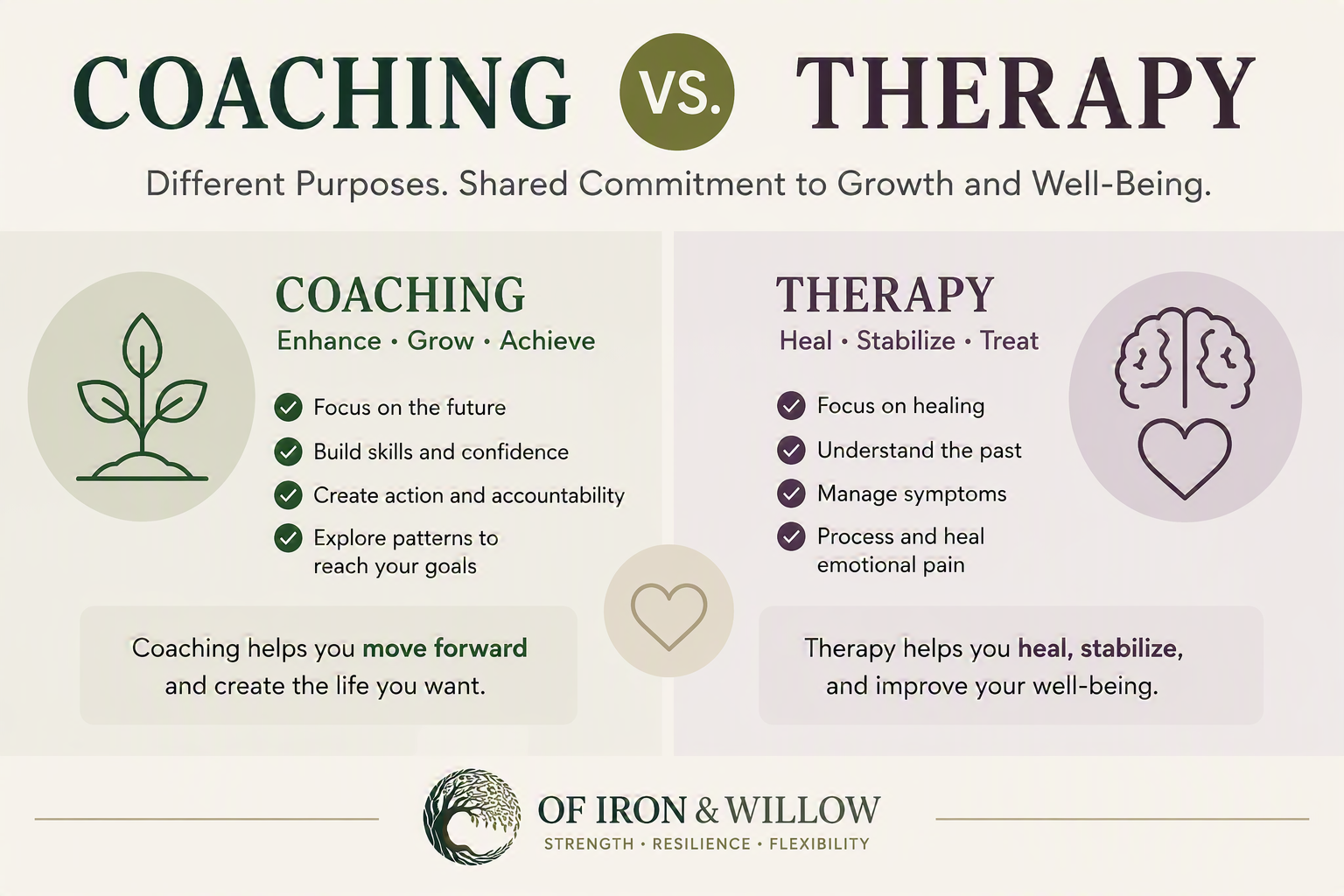
Wondering whether you need a therapist, a coach, or both? While therapy and coaching share some similarities, they serve very different purposes. This post explores the key differences between healing and growth-focused support, what each approach is designed to help with, and how to determine which type of support may best fit your current season of life.
Which Type of Support Is Right for You?
One of the most common questions we hear is:
“What’s the difference between therapy and coaching?”
It’s a great question and an important one.
Both therapy and coaching can be powerful tools for personal growth. Both involve conversations, self-reflection, insight, and change. Both can help you build a life that feels more aligned with your values.
But despite some overlap, they are not the same thing.
Understanding the difference can help you choose the type of support that best fits your needs or recognize when a combination of both may be the most helpful approach.
The Short Version
Think of it this way:
- Therapy helps people heal, recover, and restore functioning when mental health concerns, emotional pain, trauma, or significant distress are getting in the way.
- Coaching helps people grow, create change, and move forward when they are ready to focus on goals, habits, values, and intentional action.
Both are valuable. Neither is “better.”
They simply serve different purposes.
What Therapy Is Designed to Do
Mental health therapy is a healthcare service provided by licensed mental health professionals who are trained to assess, diagnose, and treat mental health conditions.
Therapy can help with:
- Anxiety
- Depression
- Trauma and PTSD
- Grief and loss
- Relationship difficulties
- Emotional regulation
- Chronic stress and burnout
- Significant life transitions causing distress
- Mental health conditions that impact daily functioning
Therapy often explores:
- Past experiences
- Family patterns
- Attachment wounds
- Emotional processing
- Healing and recovery
- Symptom reduction
The goal is often to help someone feel safer, healthier, more stable, and better able to engage with life.
Sometimes therapy involves looking backward in order to understand what is happening in the present.
What Coaching Is Designed to Do
Coaching assumes that a person is generally functioning in daily life and is ready to focus on growth, change, and creating a future that feels more aligned with their values.
Coaching is often focused on questions like:
- What do I want?
- What is getting in my way?
- What strengths can I build on?
- What habits need to change?
- How do I move from insight to action?
- How do I live more intentionally?
Coaching can help with:
- Clarifying values and priorities
- Goal setting
- Building sustainable habits
- Financial behavior change
- Career transitions
- Communication skills
- Decision making
- Accountability
- Life design and intentional living
- Dating skills
While emotions absolutely come up in coaching, they are explored in service of a goal rather than treated as a clinical concern.
A coach may help you identify a pattern, develop tools, and create an action plan.
The emphasis is typically on implementation and forward movement.
As I often tell clients:
Coaching is about gaining insight and practicing change with accountability, supportive systems, a growth mindset, experimentation, and intentional habit design.
Why the Answers Sometimes Sound Similar
This is where things get confusing.
Therapists and coaches may ask similar questions:
- “What matters most to you?”
- “What are you noticing?”
- “What’s getting in your way?”
- “What would you like to be different?”
The techniques can overlap because both counseling and coaching are based on psychological theories.
The difference is not always the question being asked.
The difference is why the question is being asked.
For example:
A therapist might explore procrastination to understand anxiety, shame, trauma, or depressive symptoms that are contributing to the behavior.
A coach might explore procrastination to identify practical obstacles, develop systems, and create accountability for moving forward.
Both conversations can be valuable. They simply have different goals.
Can Someone Have Both a Therapist and a Coach?
Absolutely.
In fact, some people benefit tremendously from having both forms of support at the same time. They just can’t ethically be the same provider, even if the therapist is trained as a coach.
For example:
A therapist might help someone process grief and depression.
A coach might help that same person develop routines, clarify goals, and rebuild momentum as they move forward.
Think of it as working on different parts of the same journey.
Therapy may help create the foundation.
Coaching may help build on it.
When both professionals stay within their respective roles, they can complement each other very well.
How Do I Know Which One I Need?
There is no perfect formula, but these questions can help.
Coaching Might Be a Good Fit If:
- You generally feel capable of functioning in day-to-day life.
- You want support creating change.
- You are looking for accountability.
- You feel stuck rather than clinically distressed.
- You want help clarifying goals, values, or next steps.
- You are ready to experiment, learn, and take action.
Therapy Might Be a Better Fit If:
- Emotional distress feels overwhelming.
- Trauma is significantly affecting your daily life.
- Anxiety, depression, or other symptoms are interfering with functioning.
- You need support processing painful experiences.
- Safety concerns or mental health symptoms require clinical care.
If you’re unsure, that’s okay.
A qualified professional should be able to help you determine whether coaching, therapy, or a combination of both would be the most appropriate support.
The Bottom Line
At the end of the day, both therapy and coaching exist for the same reason:
To help people live healthier, more fulfilling lives.
Therapy focuses on healing and restoring wellbeing when mental health concerns are creating obstacles.
Coaching focuses on growth, intentionality, and helping people move from insight into action.
You don’t have to choose one because it’s somehow “better.”
The goal is simply to find the type of support that meets you where you are right now.
Sometimes that support looks like healing.
Sometimes it looks like growing.
And sometimes it looks like both.
Disclaimer
Coaching is not mental health therapy and does not diagnose, treat, or manage mental health conditions. If you are experiencing significant emotional distress, mental health symptoms, safety concerns, or difficulty functioning in daily life, seeking support from a licensed mental health professional may be the most appropriate next step. Coaching and therapy can coexist, but they serve distinct purposes.
Ready to begin the journey?
Step into your season for growth. Together, we’ll gain clarity and nurture your vision into a tangible and sustainable reality. One that is in alignment with how you want to live and who you want to be, starting exactly where you are.